
You're Doing It Wrong
And Other Terrible Leftist Slogans

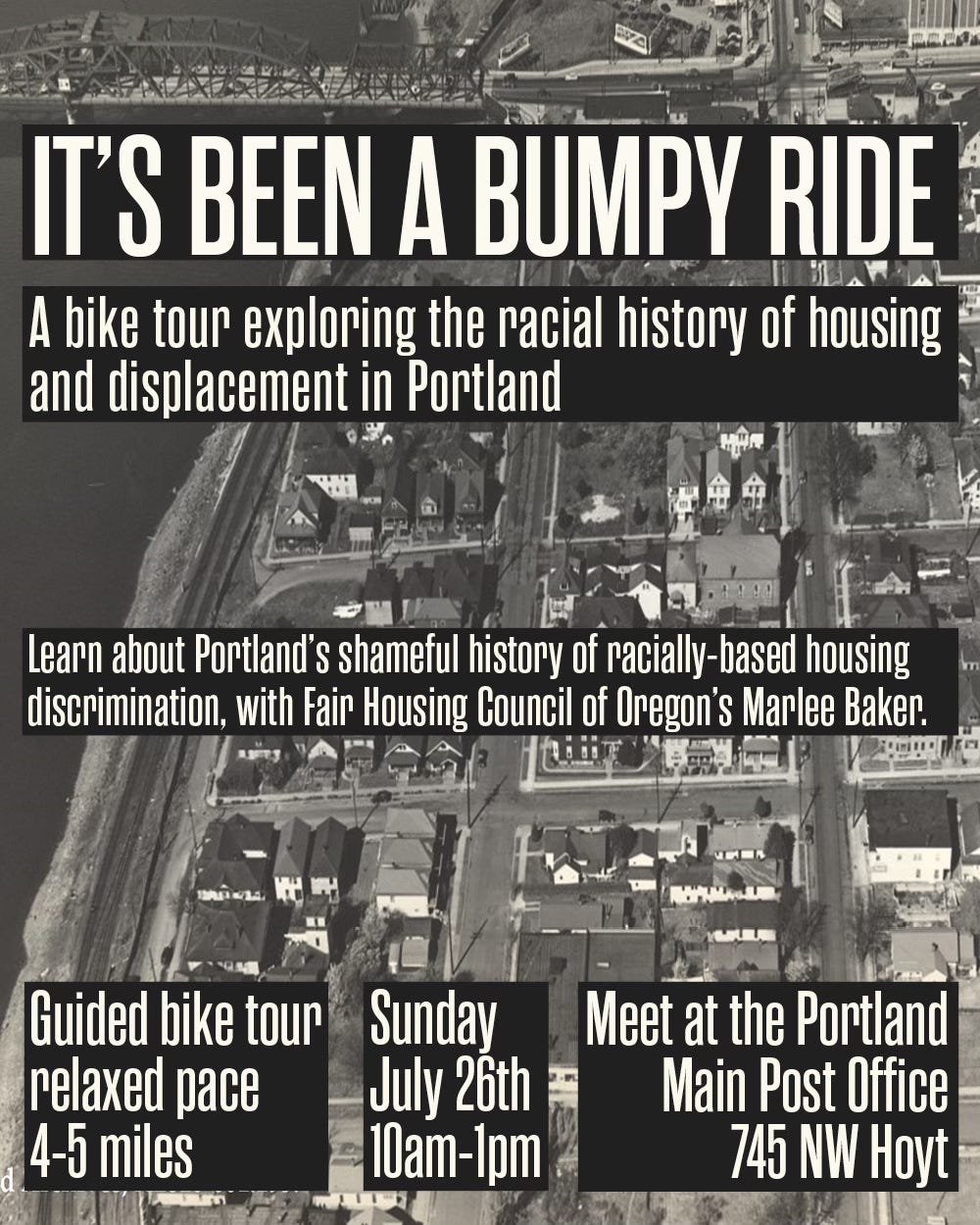
UPCOMING EVENTS: Buckle Up! It’s Been A Bumpy Ride bus tour, Thursday, July 23, 8am-2pm room for 1 guest, dm if interested. Sunday July 26, It’s Been a Bumpy Ride: Racial History of Housing and Displacement in Portland, A Guided Bike Tour with Fair Housing Council of Oregon’s Marlee Baker, focusing on downtown Portland. Lughnasa/Lammas/First Harvest Stir the Pot, Wednesday July 29, 6:30-8:30 Leaven Community, 5431 NE 20th. Last Thursday on Alberta Street, I’ll be tabling under the oak tree at 14th Place & NE Alberta, 5ish-9ish pm, Thursday July 30 & Thursday August 27. Come say hi! Umbrellas in the Shitstorm Potluck, Thursday 8/20, 5pm-9, our house. It’s Been a Bumpy Ride: Racial History of Housing and Displacement in Portland, A Guided Bike Tour with Fair Housing Council of Oregon’s Marlee Baker focusing on Vanport and the Portland Expo Center which functioned as a concentration camp when the state incarcerated over 3,800 of its Japanese citizens, Sunday, August 30.
My parents were not believers in a particular biblical system, and did not seem to hold any notion of a god that existed on a more-than-earthly plane; I was instead raised in the atmosphere of their belief in the good of humanity, and our mandate to strive to match and serve that good. They occasionally used their inherited cultural framework of Catholicism to extend the idea of that goodness outwards. Times when my parents felt like a loved one needed extra help, my mom got all of us kids to the church before dawn, on our knees in the tiny chapel to the left of the main altar. Once there, we lit votive candles in the stepped stack of small red glass holders before sitting down to pray for our friend or family member to make it through a surgery or some other mundane catastrophe.
Once, however, my mom took us all in for a completely different reason: we prayed for our friend Kathy’s sister, whom we barely knew. My mom tried to explain it to us: far away in a place called Nicaragua, farmers whose country was in a civil war were being shot and killed in the coffee fields, so Americans went to pick coffee in their places. Kathy’s sister, my mom told us, had joined them. Kathy was worried about her, and had shared her worries with my mom. While it could seem like my mom was using our youth and innocence to power her prayers, I think she just didn’t have any way to perform a solitary offering, and she also wanted to share the tradition with us, to show us a practice we could use through our lives as we encountered inevitable roadblocks or situations where there was no doing, only witnessing.
My mom grew up on a farm. Opa and Oma had a tiny farm with dairy cows, apples peaches, plums and a huge garden. Mostly they sold apples and milk. They sold the place when I was five or six, so I didn’t get much time there, but we got to visit the farm for the apple harvest a few times and it was a fun—albeit busy, and for the adults, exhausting—time. I could not remember meeting Kathy’s sister but I decided she was a tall, long-limbed brunette like Kathy, with long brown hair and freckles. I imagined her picking coffee in the sun, in a straw hat probably. I didn’t know how coffee grew, but I knew apples, I knew beans, I knew strawberries. Something like that, I figured. But with bullets, maybe. We tried to understand. Probably there were no bullets, my mom said, but maybe there would be. No one knew. And so we prayed, in our Sunday-level school clothes (pants ok, no blue jeans) for her safety, because we loved Kathy.
We did not understand how Kathy’s sister was using her privilege—her whiteness, her American citizenship—to gamble that intangible, invisible, tenuous rights were enough to protect her from agents of chaos operating in a CIA-backed proxy war against the Sandinistas. We did not understand that Kathy’s sister was fighting the Cold War with her body. In 1987, Retired Marine Col. and CIA administrative official Phillip Roettinger claimed that U.S-backed Contra rebels murdered civilians, including women and children at the Miraflores farm cooperative he visited, and speaking of the U.S., “What the administration is doing in Nicaragua is a distinct crime.”1
Destroying livestock and crops, and killing farmers is an ancient war tactic, even a secret war that violated congress and earned top military official Oliver North several felonies—for which he was of, course, pardoned. Nowadays, you can see him on Fox News’ “War Stories With Oliver North,” or hire him for a hefty speaker’s fee, in case you thought crime does not pay.
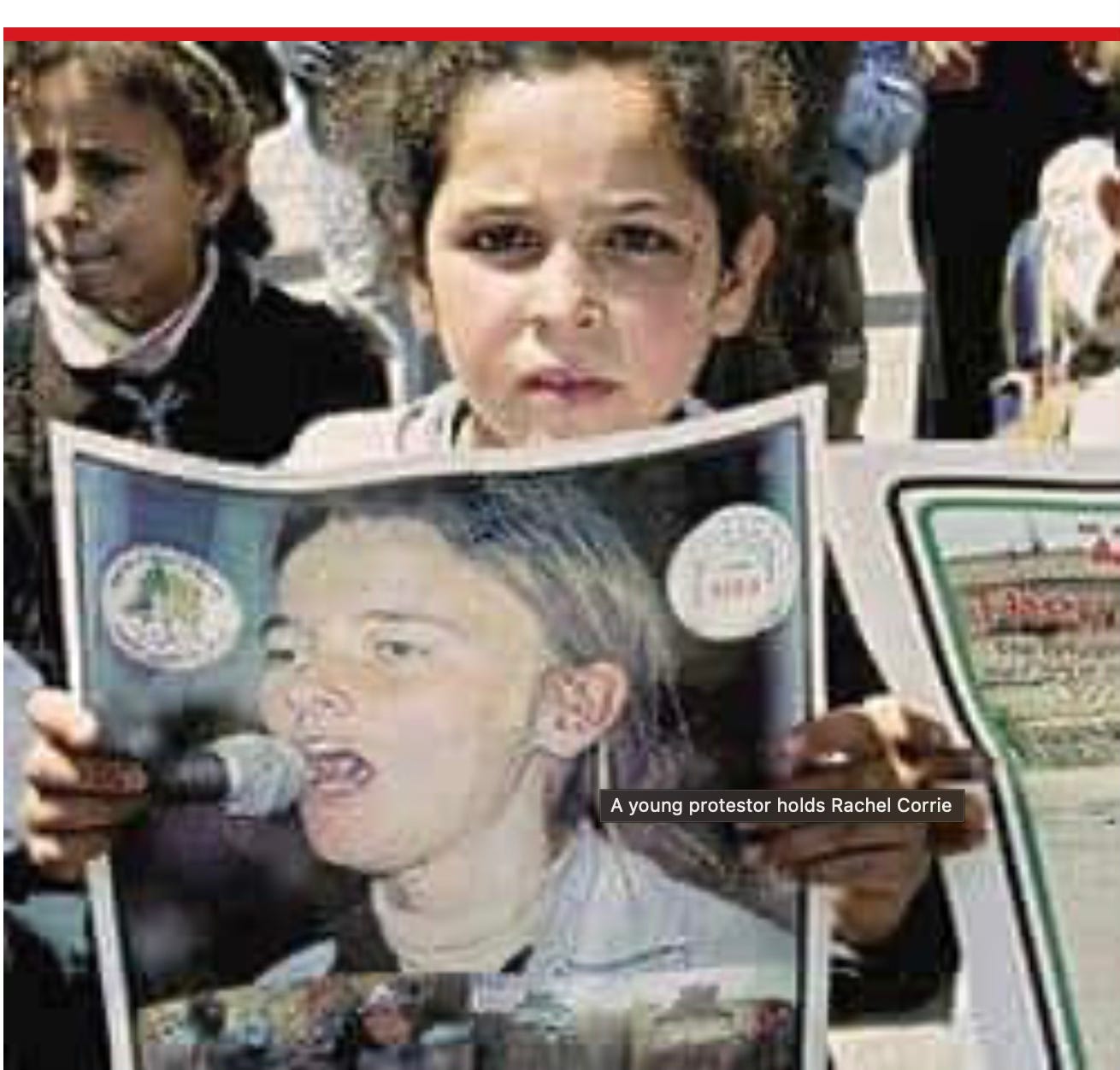
In 2003 the Pacific Northwest was rocked by the death of Rachel Corrie, a graduate of the Evergreen State College who traveled to Palestine and used her body and her American citizenship to stand against Israeli occupying forces as they bulldozed the homes of Palestinian citizens. Rachel, a close friend of someone in our community, was notoriously crushed by a bulldozer, murdered by a soldier who continues to claim that he could not see her. According to International Solidarity volunteer Richard Purssell, who witnessed her death,
“The driver cannot have failed to see her. As the blade pushed the pile, the earth rose up. Rachel slid down the pile. It looks as if her foot got caught. The driver didn’t slow down; he just ran over her. Then he reversed the bulldozer back over her again.”
The kuffiyeh that I sometimes wear was a gift from a friend who told me she got it ‘during the Rachel Corrie times.’ Rachel’s name is remembered in global nonviolence circles, from the Irish aid vessel MV Rachel Corrie which the Israeli Navy illegally seized during a 2010 aid mission, to a café in Ramallah, to songs like Billy Bragg’s The Lonesome Death of Rachel Corrie describing a “messy, skinny, chain-smoking list maker”; peace work continues in her honor, through the Olympia-based Rachel Corrie Foundation.
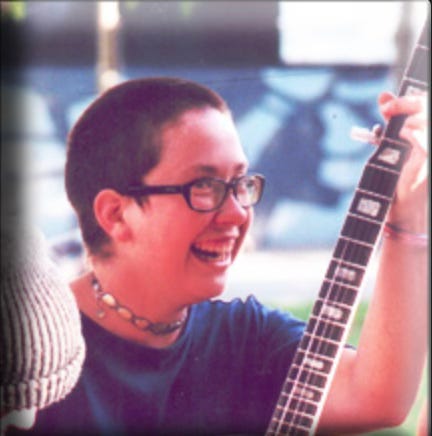
Also in 2003 we lost Beth O’Brien, a sweet young treesitter we all knew as Horehound, who overlooked clipping into a safety harness and fell to her death at the base of the old-growth tree she and her comrades were protecting while logging claims were fought in the courts. I remember meeting her dad, who came to town for the memorial and other grief details surrounding the accidental death of a young activist. He joined us in memorializing and celebrating his daughter’s commitment to her ideals, and to the protection of on behalf of beings whose lives enrich us but did not particularly affect or impact her everyday existence. Her mother wanted nothing to do with us, hated us, hated the tree sitting movement that took her daughter away. I remember describing the event to my own father, somewhat defensively as I recall; I was so surprised when he vehemently declared that if Horehound were his daughter, he would have been proud of her, and was glad his father chose to mourn with us. My role during those years of treesits was what we in the fishing industry call ‘shore support;’ we provided services to treesitters—showers, telephone use, temporary storage, a place to connect with others, a place to sleep. I think at the height of things we had eleven treesitters spend the night one time, rolled out on the living room and dining room floors.
The treesitters all gave themselves ‘forest names’ like Horehound; we joked about adopting city names like Milk Crate, or Porch. We were in our early thirties, considered old. The activists called Portland—or any settlement—’Babylon,’ made fun of us for our dependence on the corruption of civilization, even as they availed themselves of our freely offered amenities. They were often terrible guests. I remember one particularly obnoxious young man whose handsome features and arboreal boldness earned him high status in the forest scene. He leveled his righteousness at us after his fiddle was stolen off our porch where he left it overnight, and demanded we do something about it. I had no sympathy for him, countering that the city had its own wildness, we were not his parents, and what did he think Babylon was, if not a place of deceit, theft, and the worst of human vices? My main complaint was that the treesitters were engaging in a felonious act—an act that I supported wholeheartedly, and yet they did it in a way that I felt was about themselves, about their glory, about rejecting nuance for the certainty of their actions. They did not consider that when multiple guests used our house telephone—which we knew was tapped—to brag over the wire about their exploits in the treesits, we, whose names were on utility bills and leases, felt an impact as their shore support. We, whom they scorned as heedlessly committed to civilization and thus, in their binary thinking, to the death of trees, were endangered by their carelessness. They moved on after the season ended, or the court cases settled. We stayed, got kicked out of the house (technically ‘notice to vacate’ so the landlord could sell) and then had to go to court when the landlord sued us for the deposit. (He did not win.) Part of his argument was that we were ‘anarchists,’ for which he felt we should be punished. Also we were queer, we hung our laundry on the line despite the winter rain, we lived differently than he did. He told us he called the CIA on us. We knew our phone was tapped because once, while navigating a call with an operator she got a funny sound to her voice and asked me, ‘Did you know your phone is tapped?’ It was good to know that it was true, everything we heard about weird clicks indicating a tapped phone.
This spring I had a couple of houseguests who reminded me of those days, some sailors who traveled from New York via Ketziot prison in Occupied Palestine. They had been crew on sailboats that were part of the second Global Sumud Flotilla, who were allegedly followed by the Israeli navy across the Mediterranean before being illegally kidnapped in international waters hundreds of miles from Gaza. My friends were handcuffed, made to stand in stress positions, were loaded with around 400 other international activists onto a prison ship and transported to an Israeli prison before being delievered to Turkish police. They told me that the prison ship had been a 1948 gift from the U.S. government; I wondered if it was a Liberty ship from one of the Kaiser shipyards in Portland or Vancouver. How quickly we pivoted from fighting Nazis to enabling the land grab of Israel, helping equip the forces who enacted the Nakba.
It is perhaps selfish of me, but I am grateful that my specific friends were not among those who suffered sexual assault, beatings, death, or other abuse during their solidarity action, their treesit, their coffee harvest. One of the guests even got his banjo back after it remained on the disabled sailboat2; the vessel was eventually rescued where she had gone aground in the Mediterranean. The houseguest played an old blues song as a thank you, singing to me in a light clear high tenor while I hung laundry in my back yard. The guests averred that they were not traumatized, not at all; after two days of sleeping 14 or more hours at a stretch on our guest futon3, they admitted well, they might actually be a little traumatised. As shore support I left them alone, went to work, came home, offered garden and cat healing, loaned bikes, drove them to the train. They had witnessed the beatings of others not protected by the same blue passport I hold, or the white skin that the three of us live inside; Jewish and Arab activists on the prison ship, they said, got the worst of the IDF treatment. They vowed to memorialize the destroyed villages, to continue to uplift the silenced voices of the 9,600+ Palestinian prisoners who launguish in suffering.
The aftermath of this effort has also reintroduced a level of discourse I recall from the treesit days, where people deliver judgement that the sailors, as white colonizer/settler descendants, have no business on the sea, or that they did not do enough, or that they should focus on our own country’s hatred of Black citizens, the dismantling of Civil Rights, the kidnapping of immigrants based on skin color rather than citizenship. That they are doing it wrong.
I recently watched Ian Bell’s WTO/99, an archival documentary about the 1999 resistance to the World Trade Organization, famously dubbed ‘The Battle of Seattle’ in the aftermath: opening scenes show protesters wearing kuffiyehs. I remember Rachel Corrie. I remember the kuffiyehs at all the 1991 antiwar marches in Chicago when we protested what we now call the First Gulf War, Operation Desert Storm. There has been a throughline of speech offered on behalf of the Palestinian right to exist for as long I have been going to protests, I remember seeing kuffiyehs in 1986 at the annual March on Washington. U.S. activists have been standing in solidarity with Palestine since the Balfour Declaration, I expect. We don’t have a lot of support all the time. There’s not widespread knowledge, for example, that the editor of the Atlantic worked as an Israeli prison guard—or as he prefers to sanitize it, as a ‘prison counselor.’ My father, a lifelong leftist and fervent believer in political nonviolent strategy, was devoted to The Atlantic. It took the combined efforts of my Gen Z nephew and myself to bring my dad to an understanding that no, the atrocities on the news that were visited on Palestinians were not exaggerated. The power of the press is so influential, it feels like a trope even as it undermines people who pride themselves on rational thinking.
On July 16 at a State Department meeting convened to addressed the bogeyman of ‘radical left terrorism’, Shite House ghoul Miller gave a speech worthy of top Third Reich propagandist Josef Goebbels that basically gives carte blanche to vigilante-aspiring citizens to decide for themselves what is or isn’t ‘normal.’ From the World Socialist Website report on what they term July 16’s ‘Fascist Conference:’
“It’s not a coincidence that when you look at these violent antifa4 demonstrations and you see any photograph of those who were assembled—to be blunt, not one of the people that is demonstrating looks like a normal person. Not one looks normal. They’re all deformed in some way—in their appearance, in their dress, in their mannerism. Why is that? Why? If you look at two photographs and you see a normal American in the street and you see an Antifa protest, why do the people that are violently demonstrating—why is there not one normal-looking person among them? Every one of them, through the course of their life and their decisions, has scarred their body and their appearance in many different ways, to the point in which their outer appearance becomes a manifestation of their inner hatred.”
I wonder how many people who decide what ‘normal’ is recall that Goebbels was disabled, specifically due to a congenital foot deformity that caused a lifelong limp that disqualified him for service in World War 1?
While the most recent sea flotilla has already faded from the media and the Libyan interference that aborted efforts of the North African Land Convoy in support of Gaza did not even make my news feed, the genocidal clearance of Palestine continues. Support at a political level in this country is inching towards an expression of humanity that I personally fear has been abandoned by career politicians, but I’d love to be wrong. My phone today blew up a little bit with notices: on July 15, Politico reported that number 2 House Democrat Katherine Clark (D-Mass.), along with 100 other Dems, supports an amendment put forward by Rep. Thomas Massie (R-Ky.) that would cut aid to Israel—a break with Minority Leader Hakeem Jeffries.5
At every level, resistance can exist—among the clip-cloppy halls where polished shoes ring out on the polished floors of Congress, down to the most fiercely bedraggled, slogan-bearing bicyclist who refuses to agree with anyone who does not hold their specific set of beliefs. Resistance to imperialism, both at home and abroad, has existed for my lifetime, in my own experience as both participant and witness. And through all these years I have also heard that we are ‘not doing it right.’
The Subversion Through Friendliness pivot is to hear embedded within that organization-killing phrase an expression of a heart broken by the cruelty of the rich, the ignorant, the ill-informed, the rich-aspiring. Either that, or people are doing the work of the fascists, either with intention or carelessly . Don’t let them into your heart. When the words ‘you’re doing it wrong’ pop up unprompted in my head, my heart, I try to say Thank you instead, thank you to whoever is doing it ‘wrong.’ Thank you for doing it. Thank you for resisting, furious judgmental 20-year old, blasé career pocket-stuffing politician, earnest know-it-all Gen Z, and even us—jaded, bitter, nostalgic, possibly woo Gen Xers. The target is the ghouls, the cannibals, the vampires who feed on the working people, who would have us all be zombies who shop and scroll—not our comrades. When I read the autobiography of Chicago anarchist agitator and widow of Haymarket martyr Lucy Parsons, I was disappointed to learn of the intense and vicious well-documented infighting that plagued the left. Nowadays, I am disappointed to see dear friends condemn (on social media, which operates like drone warfare, lobbing attacks divorced from consequence) anyone who does things differently than they think it should be done, thus keeping that terrible tradition alive. Is it based in insecurity? There is enough resistance to go around.
Did Horehound and Rachel Corrie do it wrong? Or did they just do it differently than we would, without the hindsight hammering the importance of safety straps or the sheer brutality of the IOF, and suffer consequences? We can keep their spirits alive in our hearts by learning from them and the many many others who have placed their (white) bodies on the line and received life-ending lessons. As white people, I believe our best action is to join existing organizations and support the vulnerable. As Scot Nakagawa said in It Did Happen Here, ‘Join something.’ The challenge is to be part of something that is vulnerable to its own humanity, that might make a mistake, that might lead even one person out of a path of fascism. It’s easy to stand aloof and condemn.
stay friendly people.
For first hand accounts of the contra war, visit digital magazine Envío: Informacion Sobre Nicaragua y Centro América
According to my friends, the boats were intentionally disabled and cut loose, which created a navigational hazard in the Mediterranean, but also made it possible for other squads to locate and recover the resource.
we are giving this double-sized frame and futon away, would you like it?
Regular reminder that ‘antifa’ is not an organization but the idea that fascism is bad.
Jeffries opposed the amendment as being “overly broad.”
Thank you Moe. Your words are, as ever, hope and solidity and through-line.
I love this so so so much