
Cranking Away
Crankiness, Evolution
Announcements: Umbrellas in the Shitstorm Potluck, Thursday April 16, 5-9 pm our house, Beltane Stir the Pot Wednesday April 29, 6:30-8:30pm Leaven Community, 5431 NE 20th at Killingsworth; For the long planners, I’ll be performing at the Connecticut Sea Music Festival in Essex, Connecticut, June 12-15.
One of my co-workers sometimes goes weeks without talking to me. He is a father of three preschool age children, and came to the hospital from a career at UPS. We work together one weekend day.
This is my first corporate job; I’ve usually worked with and for people I like and love1. People frequently tell me how they don’t want anyone at work to know anything about them, and I understand that compartmentalization is a strategy, but it is a confusing habit to learn after 49 years of volunteer2 and paid work among family and friends.
My first paid job at age 11 was taking care of our neighbor’s ten Siberian Huskies; a long-distance trucker, he was often away. The dogs made my life bearable as I moved through middle and high school, bullied and shunned as a person who did things differently than what was considered, in our small town in the 70s and 80s, ‘normal.’ I loved the dogs with the desperate gratitude of a lonely kid; they taught me how to cheerfully manage unpleasant chores like chipping two inches of ice packed with pee and poop on their kennel floors for hours. I loved to make their lives better. I worked with my two younger sisters, whom I also like and love.
Try as I might, I tend to take it personally when someone does not talk to me. But after a two-month stretch of ignoring me, my co-worker—son of not just an immigrant but a former child soldier refugee—went on a 30-minute tirade about someone who did not merge properly on the freeway. He and the other driver pulled over and got in a verbal fight, which seemed to involve my co-worker waving a gun around. My co-worker made sure to let me know that the driver was from a different religious and ethnic background, and stopped short of making overtly xenophobic remarks as his face grew redder and redder. He’s in the process of getting full sleeve tattoos, an objectively painful experience. He never puts away the freight and I suspect it’s because his body suffered damage after years at UPS. Rather than acknowledge this to me, he tells me he has a headache, or his tattoos hurt, or it’s not our job. He’s not my boss but delivers messages as if he is; I started to doubt myself. I went to the boss and asked him to tell me directly what the weekend crew responsibilities are. The boss sent an email to the three of us who work weekends (I am the only one who works both days) explicitly stating the expectation that we put away freight.
I did not do this because I think that my co-worker is shirking. I don’t care if he does it or not. The warehouse just spent three months moving almost every single item to a different location every week, creating an absolute nightmare for everyone. When nurses called for items, I could not tell them whether we had them, much less find them. When I texted the boss, who somehow spends his weekends able to respond within 15 minutes to any request, he could not tell me. It was like a waitress anxiety dream, except it was every weekend for 8-10 hours. Freight location stickers were useless. I’d stack cases onto my cart: inflatable mattresses, skin staplers, or any of the numerous products to mop up human leakage, and roll them to the indicated warehouse shelf, only to find abdominal binders, or lube, or baby wipes. I gave up on putting away freight during the chaos and it did not seem to bother the corporate monster within whose belly I toil, so truly I don’t care if my co-worker puts the freight away or not. I just want to know, is it my job to put away freight?
I wish I cared less about doing a good job. The other co-worker, a Gen Z, exudes a cool, unruffled demeanor, operating with silence and projected efficiency. He is glued to his phone. The first time I saw him break character was when he acknowledged some sort of work obligation. “I don’t care,” I said, “I mean, who wants to work? It’s a hostage situation!” He barked a laugh, and I could see the warm person he is. He seems to be a little bit of a bean counter; by his calculations, since there are usually four pallets of freight per weekend, he does one, I do two—one per day—and Tattoo Guy does one.
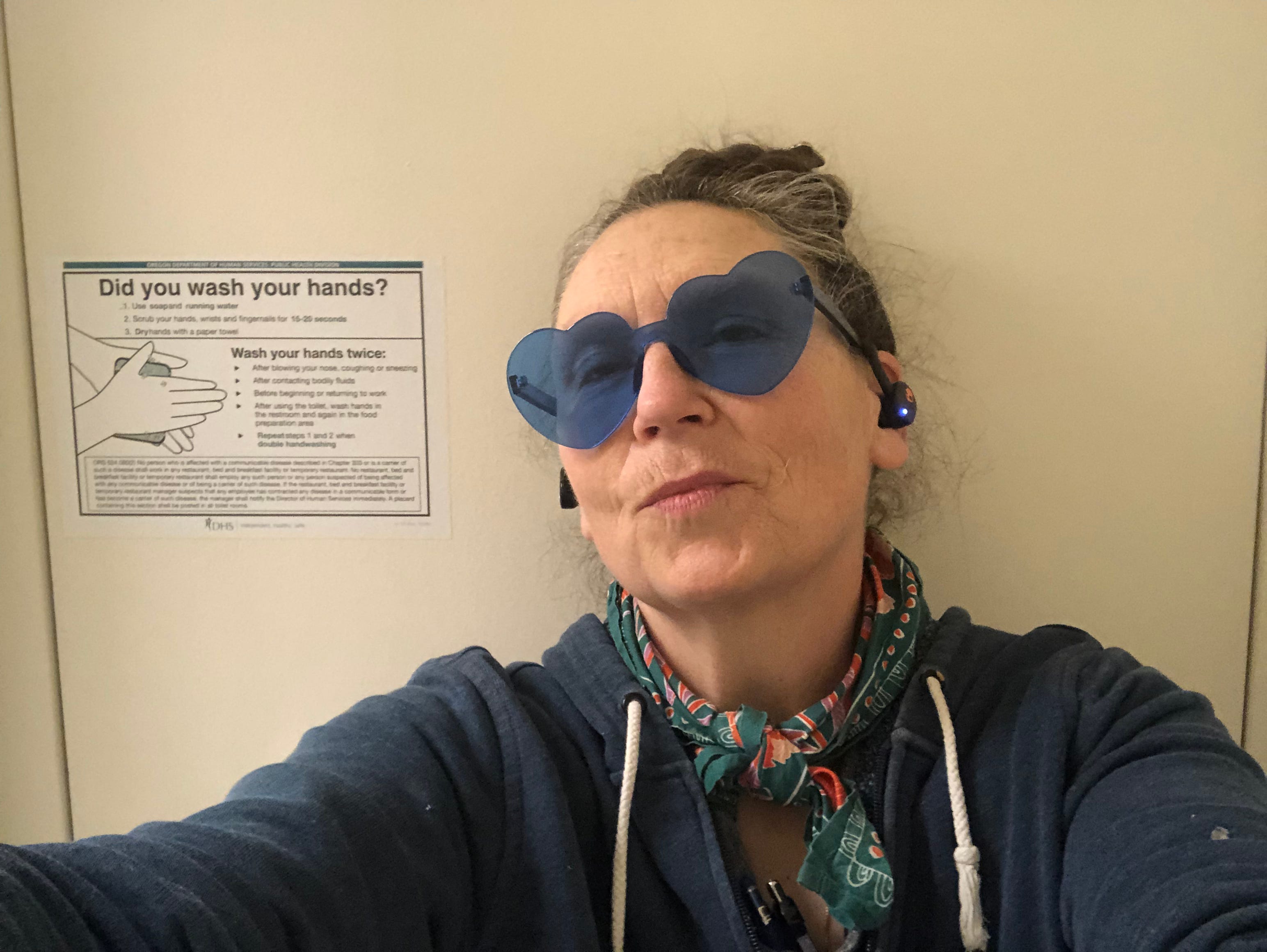
What actually happens is that Tattoo Guy unloads zero pallets, Gen Z guy unloads the easiest pallet (one pallet of all the same thing, so you just pallet-jack it over to the location and shift it onto the shelf) and I do three pallets and spend hours reverse-shopping around the warehouse. Both my co-workers are younger and bigger than I am, and yet I’m working them under the table, in my brightly colored clothes and heart-shaped pink or blue glasses that I wear to deal with the fluorescent lighting that gives me headaches. I’m the one to whom people in the hospital comment, isn't that heavy? as I carry a case of normal saline or push the 6’x1.5’ cart down the hallway, recalling the 5’x 3’ iron crab pots I used to push around on a January crab deck 18 years ago. I’m the one whom the boomer imaging nurse ‘helped’ push my cart down the hall, let it go and went into her area after unbalancing 50 bottles of blood culture that then spilled out onto the busy emergency department back hallway, reinforcing the story that I can’t manage my cart.
I feel like my co-workers are working as hard as they can to be Normal and Fit In and I am working as hard as I can to not go more crazy than I already am. And by crazy, I mean, manage my PTSD/anxiety that has been going through the ROOF the last three months. My coping methods include the colorful clothing, the glasses, listening to freeform radio, singing with the cardboard dumper, crying in the hallway, the bathroom, the supply room, talking on the phone while I put away the freight, telling jokes to the nurses and also humorously scolding the nurses for constantly apologizing. “You’re doing great!” I yell down the phone, “You are amazing! I’m rooting for you!” and hearing their voices change, hearing them actually receive the positive reinforcement all the way into their bodies, that’s one of the things that nourishes me at work. Also yelling. One of my favorite parts of working in a warehouse is that I can yell when I get worked up—usually on the phone, but I also yell sometimes in conversation with my Friday swing shift co-worker during our 2-hour shift overlap.
I am cranky, and frightened, and overworked; I think we all are. I require a lot more time alone, as well as a lot more time with people doing things that nourish me, in order to be mentally ok. Some of the things I am doing with people involve creating strategies to respond to government agencies planning to steal our neighbors, family, friends, and co-workers, which is somewhat nourishing, but also increases my fear and crankiness. I’m cranky about the well-documented experience of aging into invisibility as a woman-shaped person, while doing more of the physical and emotional labor of my younger, bigger, male-shaped co-workers. I’m frightened AND cranky about the prospect not only of everywhere war and fascism, climate and species collapse, and the horrors regarding vampiric behavior of oligarchs towards the bodies and spirits of children. And I wonder how the male-socialized, heteronormative people in our lives are going to meet this moment.
In patriarchy, male-socialized people are not permitted to be whole people, as in, beings who have emotional experiences and learn how to regulate themselves through navigating their feelings. As former NFL defensive tackle, fiber artist3 and fellow Cancerian Rosey Grier sang on the 1972 album Free To Be You And Me “It’s all right to cry, crying lets the sad out of you.” But it’s not all right to cry, is it? No matter how many times we listen to the esteemed Mr. Grier—who as one of twelve children worked days more in his father’s cane and peanut fields than days he was able to attend school—instead of crying, we become furious with people who fail to merge properly, or for any other reason we come up with in the moment to justify this toxic mix of feelings. We are invited to rage, we are invited to numb, we are invited to stuff it down. We are invited to eat emotionally, certainly. And women-shaped people are socialized to manage, interpret, explain, excuse the emotions of the people for whom patriarchy denies a full range of emotions.
I remember when my mother found an academic paper, printed it out at her job and kept in a file folder to show me when I came home on a visit from college; the paper was from a study of ethnically Irish men (like my father) who were not culturally permitted any emotions except rage—unless, my mom said, they were drunk. These sorts of studies continue, with papers like this June 2025 open access paper by Donagh Seaver O’Leary and Alan McAuliffe from the British Association for Counselling and Psychotherapy identifying that
“Vine et al analysed natural language production in a sample of 530 non-clinical participants and found that females were associated with higher emotion vocabularies. Conversely, men, in general, tend to be better interoceptors (perception of internal states) but worse emotion labelers, indicating that culturally mediated developmental reasons may be relevant for differences in emotional relevances in Emotional Dysfunction ability. It would appear that men are socially conditioned not to engage in emotion-based communication and consequently experience difficulty in employing emotion language. Resultingly, help-seeking itself may be limited by such vocabulary limitations. Such cultural influence was seen in a study of Irish adolescents, where large sex differences were seen in coping with negative affect, with males participating in more externalising behaviours, such as aggression, and less verbal emotional expression.”4
from “Am I Ok? Investigating the Lived Experience of Emotional Differentiation in a Sample of Irish Men.”
Last January this queer nurse I like walked in on me while I was surprise-crying5 about a recent death. “How ya doin?” she said, the standard greeting. The accepted response is, of course, “Fine!” or “Living the dream!” but I took a chance and ruefully said, “Oh, just doing a little crying in the supply room.”
“My favorite place is the bathroom by imaging,” she said, as she grabbed a few syringes and swung out with a kind smile.
I thought about her two weeks ago when I found myself in deep despair on a Saturday due to an unfolding crisis over which I had no control. I cried on my plastic cart and felt my spirit leak out onto the concrete floor of the warehouse. I was frustrated about being downhearted halfway through the weekend; such feelings are ok on a Sunday but when they happen on Saturdays, it can get hard to climb out. I trudged through the gray aisles, filling the tubs with all the individually-wrapped plastic medical doodads that have, according to our company’s pencil-pushers, been part of the hospital’s 47% increase in healthcare costs over the last four years, and grouched about how I was going to get through the weekend. The tv I used to watch on my friends’ passwords has finally figured out how to kick us all off, and all the shows pretty much suck, presenting no real solutions besides short term distraction and long-term despair. Social media is off limits also; I poisoned myself a few weeks ago and noticed a very specific and lasting impact so I’ve been staying away. Everything felt horrible. How was I going to turn it around, I wondered as I felt a deep grump emerging to devour me. I left the warehouse to make the delivery.
Up in the stock room I thought about that nurse and her favorite place to cry. When the door swung open and a man-shaped person in scrubs began rummaging in the supplies, I asked on an impulse, “Where’s your favorite place to cry at work?”
He became suddenly still, then dropped his head. “In the car. I just go from case to case, holding it.” He turned to look right at me.
Now, what I want to emphasize here is the very explicit hierarchy of the hospital, at the very bottom of which are the cart-pushers: warehouse, cleaners, cafeteria. People interact with the carts, rather than the people pushing them. I did not know this guy at all, I figured he was a nurse from the Resource Pool. “Are you an RN?” I asked him.
“I’m a doctor,” he said, “Thank you for asking me.” This is the most humanity any doctor has ever shared with me in four years of working at the hospital; it took one question. My spirit zinged, the way it does when I authentically connect with other humans. I took the question all around the hospital, and was fascinated at how quickly everyone answered it. I felt so lucky to be an artist, to have my capacity and skill at social practice save me from the very real despair that surrounds us all, everywhere, inviting us in, as we connected over the question. People became very engaged. “Oh, I’ve been here 16 years,” one nurse in Overflow told me, “I don’t cry at work anymore. I vent, then let it go.” Another said, “Oh, at the desk. I’ve been here 16 years. I don’t hold it in.” Her desk neighbor, a nurse I have always experienced as an extremely difficult communicator, leaned in, “I’m an internal cutter.” she shared. It was like that everywhere. No pause. Immediate mutual recognition of a regular face-off against despair, helplessness, loss. Cafeteria, engineers, ambulance drivers, a naturopath.
How we tend that yawning maw of fear, grief, loss, uncertainty in these coming days of chaos will be how we experience life, in my opinion. So many people I know are managing family and friends in hospitals, in crisis, in rehab, in graves. Safety nets are threadbare. I am trying to adapt, learn, be agile, accept and prepare to receive grief and despair as if I were preparing for a match as a martial artist. Old coping skills no longer suffice; when everyone I call in a crisis has their own crisis, how does that work? What happens to all of us who use the substances? Drugs, alcohol, gambling yes, but also phone, shopping, rage—or as “Am I Ok?” calls it, “externalising behaviours, such as aggression.”
I am looking over both shoulders at what I fear could become a roiling tsunami of social unrest as male-shaped middle class people see their jobs, their identities erased by AI, as we are seeing currently in Hollywood, where Paramount alone laid off 10% of its workforce last fall. How are male-socialized people going to manage the loss of identity that comes with a layoff, given the emotional dysfunction statistics studied in the above article? The anger at having ‘done everything right’ and still getting fucked over after years of loyalty and skill accumulation? Over one shoulder I see descent into rage, loss of composure over minor traffic irritants, externalizing aggression, outward abuse. Over the other shoulder, I see a great sinkhole of loathing that threatens to pull everyone down into it, into addiction, distraction, self-hate. At whom is that rage directed? Who will get sucked into care or become targets when self-loathing consumes? Women-shaped people? Children? Will we fall for government-sponsored hustles of racism and xenophobia as a solution?
Last weekend I cut off my co-worker’s rant, saying, “You know, I was bitching like that to a friend and he reminded me that everyone is doing the best they can, even when the best is pretty terrible.” I told my Gen Z co-worker that Tattoo Guy just doesn’t put away freight, which is fine with me; while he continues to choose the easiest loads, Gen Z now does two pallets. Sometimes I don’t do any of the rest, and sometimes I do them all. We are all doing the best we can, and we can always improve.
When I asked Tattoo Guy about his favorite place to cry at work, he said, “I can’t remember the last time I cried. As for me, I am a free-cryer, meaning I cry where I’m working. The glasses help, people automatically think I’m happy, because, heart-shapes and colors. Do I have a solution? Do I only have questions? Is curiosity a solution? I know when I started asking people a real question, the despair vanished. Is finding the right question a key to finding a solution? If the solution shifts with every crisis, is it the method that’s important? What works for you?
stay friendly people.
Paid subscriber bonus! George offered to share this tribute to his father, and we are putting The Skipper’s Heart behind the paywall. You can read it for as little as $5 today or wait a while and get the print version.
Keep reading with a 7-day free trial
Subscribe to Subversion Through Friendliness to keep reading this post and get 7 days of free access to the full post archives.